Mathematical, Statistical and Computational Modelling for Engineering
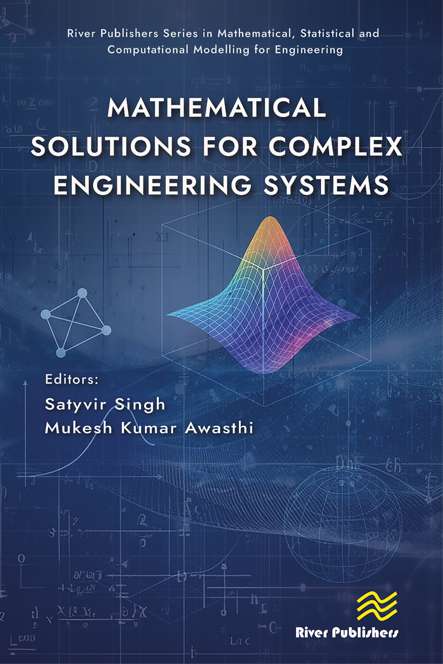
Mathematical Solutions for Complex Engineering Systems Forthcoming
Editor: Satyvir Singh, RWTH Aachen University, Germany
Mukesh Kumar Awasthi, Babasaheb Bhimrao Ambedkar University, Lucknow, India
ISBN: 9788743806684 (Hardback) e-ISBN: 9788743806677
Available: July 2026
In an era where engineering challenges are becoming increasingly multifaceted, Mathematical Solutions for Complex Engineering Systems serves as a comprehensive guide bridging the gap between theory and real-world applications. This book explores advanced mathematical modeling techniques, computational approaches, and optimization strategies that drive innovation across various engineering disciplines.
This book brings together a diverse collection of research contributions that highlight:
- Deterministic, stochastic, linear, and nonlinear models essential for analyzing multi-physical systems, from fluid dynamics to reliability engineering.
- Cutting-edge methods such as finite element analysis, boundary element methods, Keller box techniques, and machine learning-driven modeling for solving complex engineering problems.
- Case studies on nuclear power plant reliability, eco-epidemiology, nanofluid heat transfer, and pesticide impact on agricultural sustainability.
- Novel mathematical frameworks, including fractional Taylor wavelets, B-spline methods, and variational principles, for tackling nonlinear differential equations.
- Advanced concepts such as tunnel mathematics, meshfree methods, and high-resolution computational fluid dynamics (CFD) models for solving contemporary engineering challenges.
Designed for researchers, engineers, and graduate students, this book provides a robust foundation in mathematical techniques and their practical applications. With contributions from leading experts, it offers a unique blend of theoretical depth and computational efficiency, making it an essential reference for tackling modern engineering complexities.
- Chapter 1: Recent Innovations and Advances in Mathematical Modeling for Engineering Systems
- Chapter 2: A Study of Approximation Techniques used to Solve Queueing Models that Arise in Optimizing Complex Engineering Systems
- Chapter 3: Stochastic Modeling in Engineering Systems: A Study of a Nuclear Power Plant System
- Chapter 4: Nonlinear Dynamics and Chaos in Engineering Systems: Through an Epidemic Model
- Chapter 5: Eco-epidemiological Analysis of Plant�??Herbivore Interactions: The Allee Effect and Time-dependent Dynamics
- Chapter 6: Impacts of Pesticides and External Interventions on Crop Production: A Modeling Approach
- Chapter 7: Tensor Foundations of Tunnel Mathematics
- Chapter 8: Boundary Element Analysis for MHD Stokes Flow through a Microchannel Exhibiting Surface Roughness
- Chapter 9: Numerical Investigation of Non-Darcy MHD Boundary Layer Nanofluids Flow Over a Non-linear Stretching Surface
- Chapter 10: Extended Hydrodynamic Models for Rayleigh�??Brillouin Scattering in Polyatomic Rarefied Gases: A Comparative Study
- Chapter 11: Nodal Discontinuous Galerkin Framework for Solving Grad-17 Moment Equations in a Rarefied Regime
- Chapter 12: Exploring the Method of Fundamental Solutions for Nonhomogeneous and Nonlinear Partial Differential Equations
- Chapter 13: A Fractional Order Taylor Wavelets Approach for the Numerical Simulation of Fractional Variational Problems
- Chapter 14: New Fourth-order Efficient Numerical Solutions of the Klein�??Gordon Equation
- Chapter 15: Numerical Approximation of the Sine�??Gordon Equation by Using the Hybrid B-spline Differential Quadrature Method
- Chapter 16: An Overview of High-resolution Schemes in the OpenFOAM Toolkit